A batch step that loses information
This page is entirely about sample partitioning (optimize_partition): no rule is
fitted and nothing is predicted. It enters through Door 1 — a
precomputed score table, eight rows of it — and it exists to make one theoretical result
runnable. The theory is Chapter 9; this page is the
demonstration.
The result is a negative one. Chapter 8's Theorem 3 says a terminal D partition is a Mahalanobis Voronoi diagram in the metric that its own retained information induces. The obvious algorithm follows: compute the metric, send every row to its nearest cell mean in it, recompute, repeat. One full-data pass per iteration and a fixed point that satisfies the geometry.
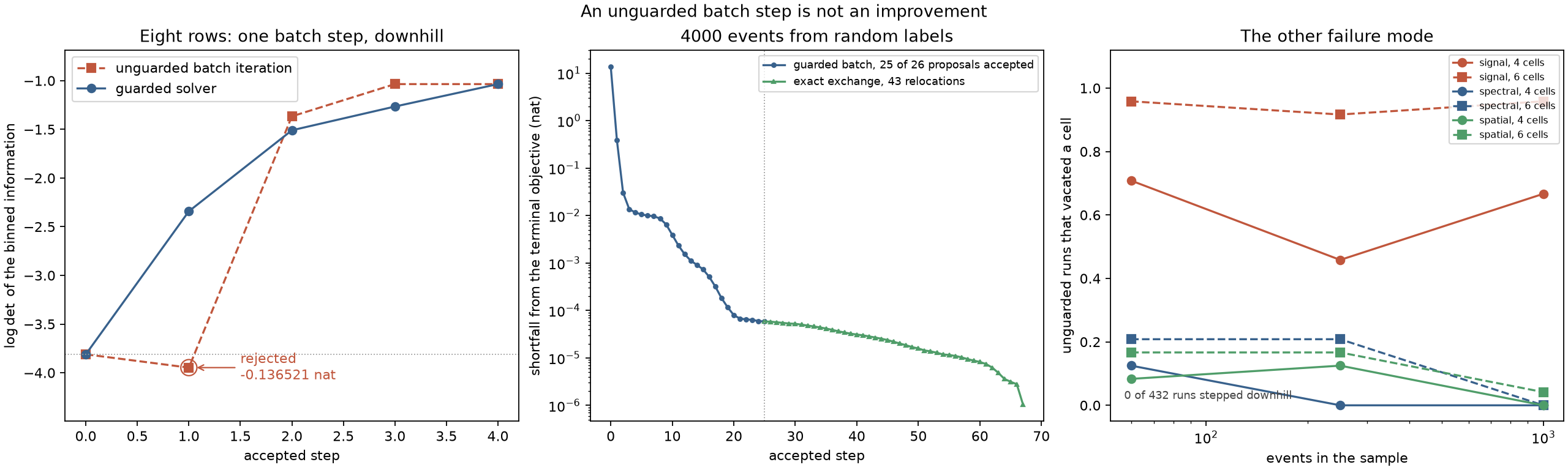
It is not monotone. One such step, on a committed eight-row fixture, lowers the criterion by 0.136521 nat while improving the distortion it actually minimizes. Everything below is arithmetic on those eight rows, plus a measurement of how often the same iteration fails in the other way it can.
Problem
Eight score rows, two parameters, three cells, equal weights. The rows and the starting labels are a committed fixture rather than a lucky draw, so the whole demonstration is reproducible arithmetic rather than a search.
import numpy as np

import scorequant as sq
from examples.lloyd_nonmonotone import (
    COUNTEREXAMPLE_BINS,
    COUNTEREXAMPLE_LABELS,
    COUNTEREXAMPLE_SCORES,
    frozen_metric_distortion,
    frozen_metric_proposal,
    raw_log_determinant,
    unguarded_trajectory,
)

scores = COUNTEREXAMPLE_SCORES
labels = COUNTEREXAMPLE_LABELS
n_bins = COUNTEREXAMPLE_BINS
weights = np.full(scores.shape[0], 1.0 / scores.shape[0])

assert scores.shape == (8, 2)
assert sorted(set(labels.tolist())) == [0, 1, 2]
Data and preprocessing
There is none. The scores are used exactly as written, and in particular they are not centered: the origin of score space is the point at which an event says nothing about the parameters, which is a fact about the model rather than an offset to be removed.
Two quantities are needed before anything moves. The criterion value is the log determinant of the binned information. The metric the criterion supplies is the inverse of that same matrix, which weights each direction by the reciprocal of the information already retained there — so a direction the cells are measuring badly counts for a lot when deciding where a row belongs.
information = np.asarray(sq.binned_fisher_information(scores, labels, weights, n_bins=n_bins))
before = raw_log_determinant(scores, weights, labels, n_bins=n_bins)

assert abs(before - (-3.810643)) < 1e-6
assert np.allclose(information, information.T)
assert float(np.linalg.eigvalsh(information)[0]) > 0.0
API walkthrough
One batch step, downhill
Freeze that metric and send every row to its nearest cell mean in it. Four rows change cell, and every one of them really is moving into a nearer cell — the assignment does exactly what it was asked to do.
proposal, means, metric = frozen_metric_proposal(scores, weights, labels, n_bins=n_bins)
after = raw_log_determinant(scores, weights, proposal, n_bins=n_bins)

assert int(np.sum(proposal != labels)) == 4
assert abs(after - (-3.947164)) < 1e-6
assert abs((after - before) - (-0.136521)) < 1e-6
The criterion got worse by 0.136521 nat. What makes this more than a curiosity is that the step improved the quantity a nearest-centroid assignment is actually minimizing: the within-cell distortion in the frozen metric.
distortion_before = frozen_metric_distortion(scores, weights, labels, means, metric)
distortion_after = frozen_metric_distortion(scores, weights, proposal, means, metric)

assert distortion_after < distortion_before
assert abs(distortion_before - 13.5450) < 1e-3
assert abs(distortion_after - 9.7464) < 1e-3
assert round((distortion_before - distortion_after) / distortion_before, 2) == 0.28
Distortion falls 28%; the objective falls 0.14 nat. The surrogate and the criterion are not the same function and nothing forces them to move together. The reason is one line of convexity: the log determinant is concave, so its first-order expansion is an upper bound, and improving an upper bound says nothing about the function underneath it.
proposed = np.asarray(sq.binned_fisher_information(scores, proposal, weights, n_bins=n_bins))
tangent_change = float(np.trace(np.linalg.inv(information) @ proposed)) - scores.shape[1]

assert tangent_change > 0.0  # the surrogate went up
assert after - before < 0.0  # the criterion went down
assert after - before <= tangent_change  # concavity, holding as it must
assert abs(tangent_change - 8.2274) < 1e-3
The guard refuses the step
MahalanobisLloydConfig never accepts a proposal on the strength of the surrogate. It
builds the proposal, rebuilds the exact criterion state from the proposed labels, and
adopts it only if the exact objective strictly improved. Started from the very labels that
produce the counterexample, guard="reject" builds the same losing proposal, measures it,
and refuses.
rejected = sq.optimize_partition(
    scores,
    weights=weights,
    n_bins=n_bins,
    config=sq.MahalanobisLloydConfig(seed=0, guard="reject"),
    initial_labels=labels,
)

assert rejected.lloyd_iterations == 1  # the proposal was built
assert rejected.accepted_lloyd_steps == 0  # and rejected
assert np.array_equal(np.asarray(rejected.labels), labels)
assert rejected.exchange_stable is False
It also says, without being asked, that the labels it is reporting are not exchange-stable — and refuses to compile them into a rule for exactly that reason.
try:
    rejected.compile_quantizer()
    raise AssertionError("an unstable partition has no theorem behind it")
except ValueError as error:
    assert "only an exchange-stable D partition can be compiled" in str(error)
The guard recovers, and climbs
The default is guard="exchange", which hands the labels to the exact positive-gain
exchange engine once the batch stops improving. On this fixture the batch never improves at
all, so the exchange does all of the work — and there is plenty of it to do.
rescued = sq.optimize_partition(
    scores,
    weights=weights,
    n_bins=n_bins,
    config=sq.MahalanobisLloydConfig(seed=0, guard="exchange"),
    initial_labels=labels,
)
history = np.asarray(rescued.objective_history)

assert rescued.accepted_lloyd_steps == 0
assert rescued.accepted_moves == 4
assert len(history) == 5
assert np.all(np.diff(history) > 0)
assert rescued.exchange_stable is True
assert abs((rescued.objective - float(history[0])) - 2.775392) < 1e-5
That is the acceptance trace: five recorded states, four accepted single-row relocations, strictly increasing throughout. Where the batch step would have lost 0.14 nat, four exact relocations gain 2.775392.
One convention has to be kept straight when comparing these numbers. The solver optimizes
in Fisher-whitened coordinates, so objective differs from the raw log determinant by the
rule-independent constant below. Differences are the same in either convention, which is
why the differences are the numbers worth quoting.
offset = float(np.linalg.slogdet(np.asarray(sq.fisher_information(scores, weights)))[1])

assert abs(offset - (-0.783062)) < 1e-6
assert abs(float(history[0]) + offset - before) < 1e-6
assert abs(rescued.objective + offset - (-1.035251)) < 1e-6
Analysis
Where the unguarded iteration goes next
The library stops after one rejected proposal, so it is worth asking what the unguarded
iteration would have done if it had been allowed to continue. unguarded_trajectory runs
the batch step with no guard at all, purely so that the page can measure what the guard is
protecting against.
run = unguarded_trajectory(scores, weights, labels, n_bins=n_bins)

assert run.outcome == "fixed"
assert run.went_downhill is True
assert abs(run.worst_step - (-0.136521)) < 1e-6
assert abs(run.objectives[-1] - (-1.035251)) < 1e-6

# The trajectory table's "Change" column.
changes = np.diff(np.asarray(run.objectives))
assert abs(changes[0] - (-0.136521)) < 1e-6
assert abs(changes[1] - 2.580919) < 1e-6
assert abs(changes[2] - 0.330994) < 1e-6
assert abs(changes[3] - 0.0) < 1e-9
| Step | Raw log determinant | Change |
|---|---|---|
| start | -3.810643 | — |
| 1 | -3.947164 | -0.136521 |
| 2 | -1.366245 | +2.580919 |
| 3 | -1.035251 | +0.330994 |
| 4 | -1.035251 | fixed point |
On this fixture the unguarded iteration recovers: it dips, climbs, and lands on exactly the labeling the guarded solver reaches. That is worth stating plainly because it is the weaker of the two things one might hope for. Nothing made it recover, the dip is real and exactly measured, and there is no bound on the dip's size on a larger table. The guarded path never goes down in the first place, which is a property rather than an outcome.
The other way the same step fails
Concavity is not the only thing that can go wrong. A frozen-metric proposal can vacate a cell entirely, and the exact criterion state cannot represent that at all: with one of \(K\) cells empty the binned information is that of a \(K-1\)-cell partition, singular as soon as \(K-1\) is smaller than the score dimension plus one. The same guard catches it, because the same rule applies — propose freely, verify exactly, accept only improvements.
This failure mode is not rare. Running the unguarded iteration from random starting labels
across three synthetic problems, three sample sizes, and two bin budgets — 432 runs
regenerated by examples/lloyd_nonmonotone.py into
assets/lloyd-nonmonotone.json:
| Problem | 60 events | 250 events | 1000 events |
|---|---|---|---|
| Signal plus backgrounds, 4 cells | 17 of 24 | 11 of 24 | 16 of 24 |
| Signal plus backgrounds, 6 cells | 23 of 24 | 22 of 24 | 23 of 24 |
| Spectral templates, 4 cells | 3 of 24 | 0 of 24 | 0 of 24 |
| Spectral templates, 6 cells | 5 of 24 | 5 of 24 | 0 of 24 |
| Spatial sources, 4 cells | 2 of 24 | 3 of 24 | 0 of 24 |
| Spatial sources, 6 cells | 4 of 24 | 4 of 24 | 1 of 24 |
Each entry counts the runs whose unguarded iteration vacated a cell. 139 of 432 did. Across the same 432 runs, not one ever stepped downhill: the concavity failure is real but is a small-sample, high-leverage effect, exactly as the eight-row fixture — where every row carries an eighth of the total mass — suggests. Two different failure modes with two different frequencies, and one rule that catches both.
A single unguarded run makes the point at page speed:
from examples.lloyd_nonmonotone import ledger_split

split = ledger_split("signal_background_shape", 60)
start = np.random.default_rng(0).integers(0, 6, size=60)
vacating = unguarded_trajectory(split.scores, split.weights, start, n_bins=6)

assert vacating.outcome == "emptied"
assert vacating.went_downhill is False
What the guard costs, at scale
The guard costs one exact rebuild per proposal. On 4000 events with six cells, started from random labels so the batch phase has real work to do:
| Quantity | Guarded batch | Exact exchange |
|---|---|---|
| Full-data passes | 26 batch iterations plus 44 scans | 48 scans |
| Accepted steps | 25 batch relabelings, then 43 relocations | 3781 relocations |
| Terminal objective | -0.074225 | -0.074208 |
Both are monotone and both terminate exchange-stable. The guarded batch crosses the bad initialization in 25 full-data relabelings and then needs only single-row work to settle; plain exchange gets there too, relocating nearly ninety times as many rows. The 26th proposal was built, measured, and not accepted — on this problem because it was a fixed point rather than a loss, which is the ordinary case.
Discussion
Task: sample partitioning only. PartitionResult has no predict_scores, and the one
result here that could compile — the rescued, exchange-stable one — is left uncompiled
because the point of the page is the labeling, not a rule.
Door: 1 for the eight-row table, which is a bare score matrix. The larger runs draw their scores from exact component densities, so they would equally be Door 2; nothing in the demonstration depends on which.
Criterion and solvers: DOptimality throughout, with MahalanobisLloydConfig under
both guard settings and DExchangeConfig for the comparison. Both pairings are ones the
dispatch table declares.
What the baselines did. They are not run here, and deliberately: the canonical baselines answer "is information-aware binning worth it", which the solver shootout settles. The comparison this page needs is between two ways of running the same criterion, one of which is wrong.
What to take away. Geometry that holds at an optimum is not a licence to iterate that geometry, because the metric moves with the partition. The repair is not subtle and not optional: it is one exact rebuild per proposal, and it turns a non-monotone heuristic into a solver whose every recorded step is certified. The theory, including why a minorize-maximize argument cannot be repaired here, is Chapter 9.
The matching notebook,
lloyd_nonmonotone.ipynb,
runs the full ledger, prints every table above, and re-renders the figure.